What Is the EU AI Act?

The EU AI Act classifies AI systems by risk and assigns obligations accordingly. Instead of regulating the technology itself, it regulates how and where AI is used — and how much potential harm a given use case carries.
It also applies based on your role in the AI value chain. Most SMEs are deployers (you use an AI system in your operations), not providers (you build and place one on the market). Deployers carry far lighter obligations than providers — an important point most scare-mongering misses.
⚖️ The Four Risk Levels — and What They Mean for You
Every AI system falls into one of four tiers. The table below shows where most small businesses actually land.
| Risk level | Typical examples | What it means for your SME |
|---|---|---|
| Unacceptable | Social scoring, manipulative or covert biometric surveillance | Banned — do not use |
| High | AI in recruitment, credit scoring, education, critical infrastructure | Allowed, but strict duties (oversight, logging, documentation) |
| Limited | Chatbots, AI-generated text / images / video | Transparency only — you must disclose that AI is involved |
| Minimal | Spam filters, recommendations, most everyday SaaS AI features | No specific obligations |
Most SME AI use is minimal or limited risk. The one common trap is AI in recruitment — CV screening and candidate ranking are treated as high-risk.
📅 The Deadlines That Actually Matter
The Act entered into force on 1 August 2024 and applies in phases.
| Date | What applies |
|---|---|
| 2 February 2025 | Bans on unacceptable-risk AI + AI-literacy duties (already in force) |
| 2 August 2025 | Rules for general-purpose AI (GPAI) models + governance |
| 2 August 2026 | Most remaining obligations, including transparency and high-risk rules (Annex III) |
| 2 August 2027 | High-risk AI embedded in regulated products (Annex I) |
One important caveat. A simplification package known as the Digital Omnibus proposes pushing the high-risk Annex III deadline from 2 August 2026 to 2 December 2027. Until that change is formally published in the EU Official Journal, 2 August 2026 remains the legally binding date — so plan for August 2026 and treat any extension as breathing room, not a reason to stop.
Is My Small Business Even Affected?

Probably less than you fear — but “less” is not “none.” Three quick tests:
- Do you use a banned practice? Almost no SME does, but confirm you are not doing covert biometric categorisation or social scoring.
- Do you deploy a high-risk use case? If you use AI to filter or rank job applicants, you are likely a deployer of a high-risk system.
- Do customers interact with your AI? A chatbot or AI-generated content triggers transparency obligations — users must be told they are dealing with AI.
If none apply, your job is mainly documentation and good housekeeping. If one does, the checklist below is for you.
✅ The EU AI Act Compliance Checklist for SMEs
Work through these in order. Most SMEs can complete the core in a few focused days.
- 1. Build an AI inventory. List every AI system you use — including AI hidden inside everyday SaaS tools (CRM lead-scoring, email assistants, support chatbots). You cannot comply with rules for systems you have not catalogued.
- 2. Classify each system by risk. Assign every item a tier and record why. This document is the backbone of your compliance file.
- 3. Confirm your role. For each system, note whether you use it (deployer) or build/brand it (provider). Fine-tuning an open model and shipping it under your own name can make you a provider.
- 4. Handle high-risk systems properly. Use them per the provider’s instructions, ensure human oversight, keep logs, monitor performance, and inform affected people where required.
- 5. Meet transparency duties. Label AI chatbots clearly and disclose AI-generated text, images, audio and video. This is the rule most SMEs miss.
- 6. Get data governance in order. Document data sources, your legal basis under GDPR, retention periods and access controls. The AI Act and GDPR overlap heavily here.
- 7. Train your team. Since February 2025 you must ensure staff have adequate AI literacy. A short, documented internal session satisfies this for most SMEs.
- 8. Write it down and keep it current. Maintain a simple file: inventory, classifications, data sources, oversight measures and training records. If a regulator asks, this file is your answer.
⚠️ What Happens If You Ignore It? The Penalties
Non-compliance is expensive. Fines scale with the severity of the violation — and for the worst breaches they reach up to €35 million or 7% of global annual turnover, whichever is higher.
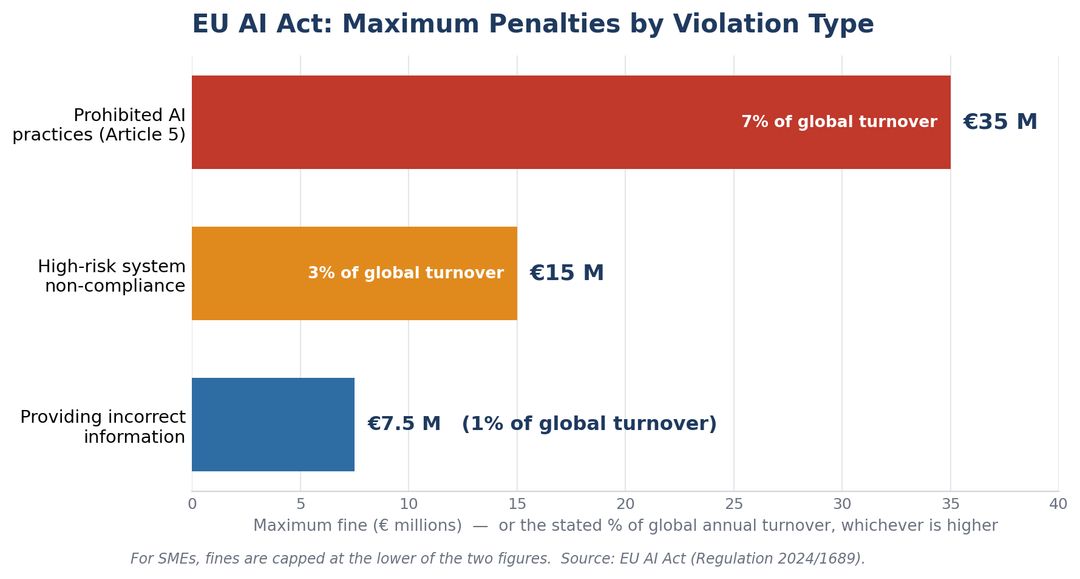
For SMEs, there is relief: fines are capped at the lower of the two figures, not the higher. The Act also offers proportionate treatment — simplified documentation templates and priority access to regulatory sandboxes. But there is no blanket exemption: the core rules still apply.
🔐 Why Where You Host Your AI Changes Everything
Here is the part most compliance guides skip. A large share of AI Act and GDPR risk comes down to one question: does your data leave your control?
When you send prompts, customer records or documents to a third-party cloud AI, you inherit that provider’s data flows, sub-processors and — if the provider is US-owned — potential exposure to the US CLOUD Act, even when servers sit in Europe.
Self-hosting flips this. When you run open-source models on your own GPU server in the EU, data never leaves your perimeter — which turns several compliance questions into simple configuration.
| Compliance factor | Third-party cloud AI | Self-hosted on an EU GPU server |
|---|---|---|
| Data residency | Depends on provider contract & sub-processors | Fully under your control in the EU |
| US CLOUD Act exposure | Possible, even with EU servers | None (no US parent, no data export) |
| Audit trails & logging | Limited to what the vendor exposes | Complete, on infrastructure you own |
| GDPR data transfers | Cross-border transfer to justify | No transfer — data stays in your perimeter |
| Model & cost control | Vendor lock-in, surprise changes | Full control, predictable costs |
For an SME, “control your own infrastructure” is often the shortest path to provable compliance.
🇪🇺 How Trooper.AI Helps You Stay Compliant
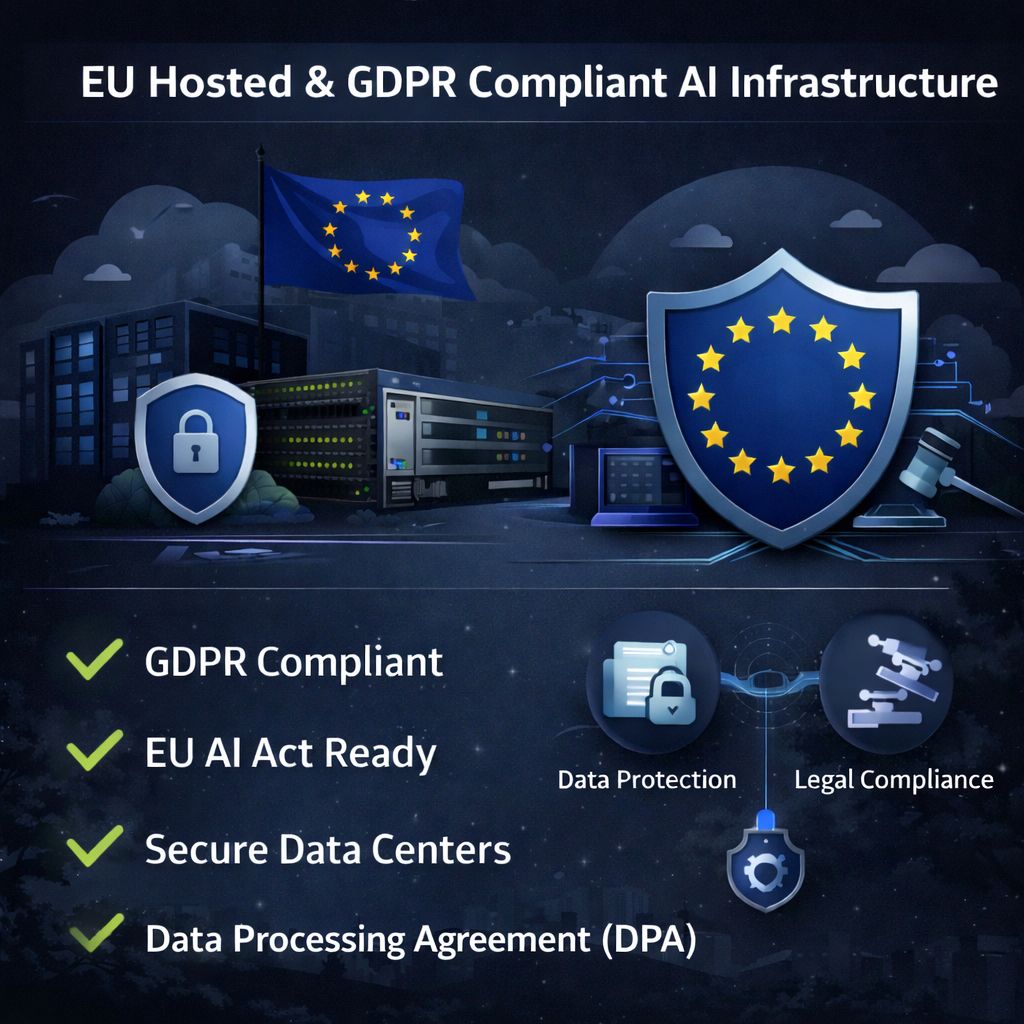
Trooper.AI rents EU-hosted GPU servers — built in Germany, with no US parent company — so you can run open-source models like Mistral and Llama entirely on infrastructure you control. That gives you the data sovereignty the AI Act and GDPR reward, without buying hardware.
If your 2026 plan involves an AI chatbot, a document assistant, or replacing a US cloud tool, doing it on your own EU server makes the checklist above far easier to satisfy.
Key principles include:
- ✅ EU-hosted infrastructure
- ✅ GDPR compliance
- ✅ EU AI Act readiness
- ✅ Secure endpoints and SSL protection
- ✅ Full root access and data sovereignty
Rent a private GPU server in the EU and start building today.
Frequently Asked Questions
When does the EU AI Act apply to small businesses?
Key obligations apply from 2 August 2026, after earlier phases in February and August 2025. A proposed Digital Omnibus may defer high-risk rules to December 2027, but until it is officially published, 2 August 2026 is the binding deadline.
Are SMEs exempt from the EU AI Act?
No. There is no blanket exemption. SMEs get proportionate treatment — simplified templates, sandbox access, and fines capped at the lower threshold — but the core rules still apply.
What are the penalties for non-compliance?
Up to €35 million or 7% of global turnover for prohibited practices; up to €15 million or 3% for high-risk breaches; and up to €7.5 million or 1% for incorrect information. For SMEs, the fine is the lower of the two figures.
Does using ChatGPT or Copilot make my business non-compliant?
Not automatically — but third-party cloud AI shifts data outside your control and can complicate GDPR and transparency duties. Self-hosting an open model on EU infrastructure removes that exposure.
Do I need to label my AI chatbot?
Yes. Limited-risk transparency rules require you to tell users when they are interacting with AI and to disclose AI-generated content.
What’s the single most useful first step?
Build your AI inventory and classify each system by risk. Everything else depends on it.

Last updated: June 2026. This article provides general information about the EU AI Act and is not legal advice. Verify your specific obligations with a qualified professional.
WHAT ARE YOU WAITING FOR?
Rent your own GPU server today and start building amazing AI applications! Trooper.AI GPU servers are built from purely upcycled high-end tech from the last years, designed to provide you with the best performance, security, and reliability for all your AI needs.
Rent a GPU Server for AI
EU location · High privacy · Great performance · Best support